Sample 1
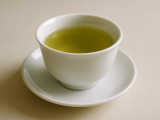
Transcript
我今天不想喝水,我想喝茶。
wǒ jīn tiān bù xiǎng hē shuǐ , wǒ xiǎng hē chá 。
I do not want water today, I want tea.
Show the answer
✓ True
This part tests whether you recognise everyday words and short phrases when you hear them. 5 questions — answer format: true (✓) or false (✗).
Each question prints a single picture. You hear a short phrase or sentence — at the lowest level often just two or three words — and decide whether it describes the picture. You mark ✓ if it matches and ✗ if it does not.
The recordings use the most frequent words of the level: people, food, numbers, time, places. What is tested is whether you can pick a word you know out of the sound, so the traps are usually a word that sounds close to the right one, or a sentence that mentions the pictured thing but says something different about it.
听录音,判断对错。
tīng lù yīn , pàn duàn duì cuò 。
Listen and decide whether the picture matches what you hear.
5 questions from our practice bank, in the format of the real paper. Try each one before opening the answer.
我今天不想喝水,我想喝茶。
wǒ jīn tiān bù xiǎng hē shuǐ , wǒ xiǎng hē chá 。
I do not want water today, I want tea.
✓ True

我在看书,这本书很好看。
wǒ zài kàn shū , zhè běn shū hěn hǎo kàn 。
I am reading; this book is good.
✓ True

他是我的老师,在学校工作。
tā shì wǒ de lǎo shī , zài xué xiào gōng zuò 。
He is my teacher and works at a school.
✓ True

妈妈今天买了三个苹果。
mā mā jīn tiān mǎi le sān gè píng guǒ 。
Mum bought three apples today.
✓ True
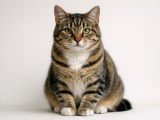
这是我的猫,它今年三岁了。
zhè shì wǒ de māo , tā jīn nián sān suì le 。
This is my cat, it is three years old.
✓ True
5. It is part 1 of 4 in the HSK 1 Listening section, which has 20 questions and lasts about 15 minutes, for 100 points.
Automatically. Every question has one correct answer and all carry the same weight. A wrong answer costs nothing more than a blank one, so never leave a question empty.
Twice. At HSK 1 every recording is played two times — use the first listen to find the answer and the second to check it.
Yes. At HSK 1 the printed words and sentences carry pinyin, so you can read the paper before you know every character. It is still worth learning the characters — the pinyin is gone from HSK 3.
No. Each picture is judged on its own, and the split between true and false changes from paper to paper. Decide every item on what you heard.
You rarely need every word. Focus on the noun and verb that relate to the picture; an unknown word elsewhere in the sentence seldom changes the answer.
Yes. HSK Test has practice sets for this part, built like the real paper. Create a free account to start; your answers and scores are saved, so you can see how you are improving.
Practise it the way it is set on the day, and see your score straight away.